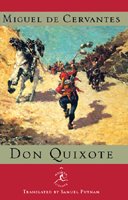
The best novel in the universe. So many richly fascinating episodes, such finely balanced tragicomedy, it is alternately hilarious and painful. The sublime visionary Quixote and the slyly Rabelaisian Sancho together form the ultimate human personality. Striking through the masks of materialism to create new spiritual values, Don Quixote proclaims "I know who I am, and who I may be if I choose."
This book has been dear to my heart and I have read it multiple times over the last decade. On my first reading, at the idealistic age of seventeen, I was enamored with Quixote's heroics, absurd though they are, and wished to be his apostle. A second reading revealed to me the richness of the character of Sancho Panza, as well as some of the darker shadings of Quixote's madness and violence. Having read it several times since, I see Quixote and Sancho as related aspects of a universal human character, as a lovely and pugnacious friendship, and as showing the best and worst in each of us, all served with generous doses of humor.
Part One is a sublime parody, and Part Two is a sublimer parody of a parody, as Quixote encounters characters who have read Part One and thus formed various opinions of him. In the decade between the writing of Parts One and Two, an anonymous author published his own spurious part two, and the inconsistencies and frustrations brought about are deliciously absurd. Cervantes was writing an extended prose narrative in a time before novels, and so he is improvising the form as he goes. At times, it all seems postmodern centuries before modernism, as stories within stories, narrators within narrators, and spurious unauthorized characters roam the Spanish countryside.
Don Quixote is episodic in nature, rather than following a classical plotline. It is crammed full of mysterious images, ridiculous situations, and slapstick humor. It is rich and lively and generously rewards repeated readings.
Friday, February 11, 2011
Thursday, February 10, 2011
Wednesday, February 9, 2011
Tuesday, February 8, 2011
Monday, February 7, 2011
Sunday, February 6, 2011
Fantasy Opera Season
Coming from the classical music blogosphere, we have the Fantasy Opera Season game. If I were a billionaire, these would be my first two seasons.
SEASON ONE:
- Ades, The Tempest
- Janacek, The Cunning Little Vixen
- Schumann, Genoveva
- Messiaen, Saint Francois d'Assisse
- Birtwistle, The Minotaur (or Punch and Judy)
- Double Bill: Carter, What Next? and Nono, Intolleranza
- Monteverdi, L'Incoronazione di Poppea
- Strauss, Die Fraue Ohne Schatten
- Berlioz, Les Troyens
- Henze, L'Upupa
- Britten, Turn of the Screw
- Schoenberg, Moses and Aron
- Mozart, Lucio Silla
- Wagner, Das Rheingold
SEASON TWO:
- Dusapin, Perela, Uomo di Fuma
- Szymanowski, King Roger
- Massenet, Panurge
- Haydn, Il mondo della luna
- Verdi, Don Carlo
- Rimsky, Invisible City of Kitezh
- Debussy, Pelleas et Melisande
- Double Bill: Stravinsky, The Nightingale and Knussen, Where the Wild Things Are
- Prokofiev, Love for Three Oranges
- Ligeti, Le Grand Macabre
- Penderecki, Ubu Rex
- Saariaho, L'amour de loin
- Mozart, Cosi fan tutte
- Wagner, Die Walkure
Friday, February 4, 2011
Book Review: The Crock of Gold
The Crock of Gold is a really wonderful, unique book that I was lucky to discover while wandering through the used book store one rainy day. Stephens was James Joyce's appointee to finish the monumental Finnegans Wake in the event that Joyce was unable to do so. The book reminded me a bit of The Wind in the Willows--it seemed that several charming novels were happening at the same time. The plot (inasmuch as there is a central plot) hinges around philosophers and leprechauns. Utterly delightful.
Thursday, February 3, 2011
Wednesday, February 2, 2011
Tuesday, February 1, 2011
Subscribe to:
Posts (Atom)