skip to main |
skip to sidebar
A great biography and a fascinating appreciation of Schumann's work. Schumann was one of the great musical geniuses of the Romantic movement, and his contributions to musical form were unique and bizarre. Daverio is especially adept at pointing out the mastery in Schumann's often overlooked large-scale later works like "Scenes from Goethe's Faust" or "Das Paradies und die Peri", finding no loss in quality due to Schumann's supposed mental illness. Ear-opening and thought-provoking, delves into Schumann's literary interests (Jean-Paul, Hoffmann, Goethe, etc.) and illuminates the ways in which he endeavored to create a new musical-literary poetics (a line of thinking that would arguably culminate in Wagner's music dramas). A great read, and it made me think differently about the way I create my own art.
This is one of my favorite books--it's a wild and hilarious fantasy that plumbs the depths and ascends the heights of humanity. The hero, Lucius, is transformed into a donkey and mingles with robbers, murderers, prostitutes, ghosts, witches, a guy with a golden nose, lovers, priests, and gods. He witnesses the whole mess of late-Roman life, from street violence and sexual degradation to the wistfulness of love and spiritual transcendence. As Oscar Wilde put it, "We are all in the gutter, but some of us are looking at the stars."
It's a sort of ribald Romana Commedia. And it's also the source of the profound and lovely tale of Cupid and Psyche, a lyrical story of symbolic love.
I made a series of illustrations to this book after reading it--you can see them here.
One of the greatest masterpieces of literature, reading this was an incredible experience. Poignant, funny, metaphysical, tragic, allegorical, psychologically profound, and highly entertaining, it bridges the worlds of heaven and earth, dreams and "reality," and is a truly astonishing achievement. Reading does not get any better than this--it really is up there with Don Quixote, The Divine Comedy, War and Peace, Shakespeare, and anything else you might name. As one Western scholar on the work noted, to "appreciate its position in Chinese culture, we must imagine a work with the critical cachet ofJames Joyce's Ulysses with the popular appeal of Margaret Mitchell's Gone With the Wind – and twice as long as the two combined"...There is an excellent review here (http://www.complete-review.com...) if you are interested (it's listed in an alternate translation as "Story of the Stone").
This was the first book of poems I acquired for myself at the age of sixteen or so (very much at random), and it's still a favorite. It introduced me to Wallace Stevens and D. H. Lawrence, two I now can't live without; but it also contains lots of really wonderful poets that I haven't found elsewhere, like Richard Aldington and F. S. Flint.
Here's a sample from Aldington (who was married to the much-more-well-known "H.D."):
I know you, poplar;
I have watched you since I was ten.
But if you had a little real love,
A little strength,
You would leave your nonchalant idle lovers
And go walking down the white road
Behind the waggoners.
There are beautiful beeches down beyond the hill.
Will you always stand there shivering?
Isn't that delightful? Lots of hidden treasures to be discovered in this little volume.
One of the most perfect books I've ever read. The story is about the relationship between a young girl and her grandmother and is suffused with the glories of the natural world, the humor and pain of childhood, and stripped of any cloying sentimentality. Tove Jansson was a truly incredible writer, and this book sings. It's a book to celebrate, and to remind you that life is delicious and that the world is overflowing with wonder.
Also, the Moomin books are quite possibly my favorite children's literature.
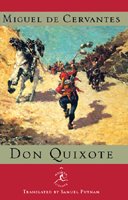
The best novel in the universe. So many richly fascinating episodes, such finely balanced tragicomedy, it is alternately hilarious and painful. The sublime visionary Quixote and the slyly Rabelaisian Sancho together form the ultimate human personality. Striking through the masks of materialism to create new spiritual values, Don Quixote proclaims "I know who I am, and who I may be if I choose."
This book has been dear to my heart and I have read it multiple times over the last decade. On my first reading, at the idealistic age of seventeen, I was enamored with Quixote's heroics, absurd though they are, and wished to be his apostle. A second reading revealed to me the richness of the character of Sancho Panza, as well as some of the darker shadings of Quixote's madness and violence. Having read it several times since, I see Quixote and Sancho as related aspects of a universal human character, as a lovely and pugnacious friendship, and as showing the best and worst in each of us, all served with generous doses of humor.
Part One is a sublime parody, and Part Two is a sublimer parody of a parody, as Quixote encounters characters who have read Part One and thus formed various opinions of him. In the decade between the writing of Parts One and Two, an anonymous author published his own spurious part two, and the inconsistencies and frustrations brought about are deliciously absurd. Cervantes was writing an extended prose narrative in a time before novels, and so he is improvising the form as he goes. At times, it all seems postmodern centuries before modernism, as stories within stories, narrators within narrators, and spurious unauthorized characters roam the Spanish countryside.
Don Quixote is episodic in nature, rather than following a classical plotline. It is crammed full of mysterious images, ridiculous situations, and slapstick humor. It is rich and lively and generously rewards repeated readings.
The Crock of Gold is a really wonderful, unique book that I was lucky to discover while wandering through the used book store one rainy day. Stephens was James Joyce's appointee to finish the monumental Finnegans Wake in the event that Joyce was unable to do so. The book reminded me a bit of The Wind in the Willows--it seemed that several charming novels were happening at the same time. The plot (inasmuch as there is a central plot) hinges around philosophers and leprechauns. Utterly delightful.